
Planning to build your dream house in Nepal in 2026? Picking the right month is not just about weather. It is also about Malmas, jug puja sait, festive season schedules, and the monsoon. Get the timing wrong and you can lose months — or worse, pour your foundation in conditions that weaken the concrete.
This guide gives you the exact dates, the reasoning behind them, and a downloadable construction timeline (Excel) prepared for Nepal 2083–2084 BS. Whether you are building an RCC house in Kathmandu, Pokhara, Biratnagar, or anywhere else in Nepal, this is the roadmap.
Related GharNaksa guides: Plan the next step with our design guide, monitoring guide, renovation service, and blog guides.
Quick Answer: When Is the Best Time to Start House Construction in Nepal?
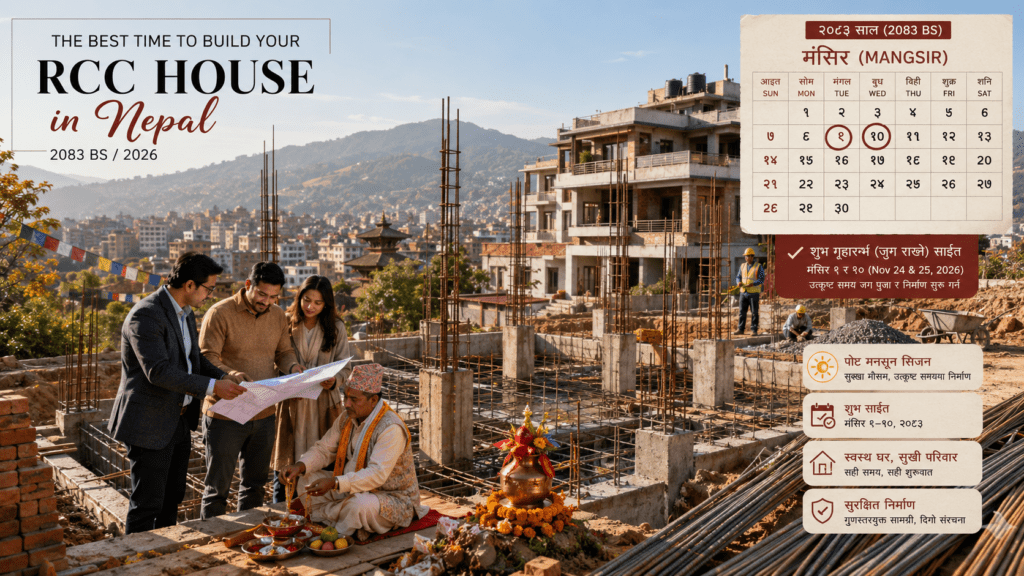
The single best time to lay the foundation of an RCC house in Nepal in 2026 is Mangsir 9 or 10, 2083 BS (November 24 or 25, 2026). This date is auspicious as per the official 2083 sait calendar, falls after the monsoon ends, and gives you the entire dry season to complete your RCC structure before the next rains arrive.
The best time to start your architectural design phase is right now — even during Malmgas. Design work is not a shubha karma and can begin any time.
What Is Malmas and Why It Matters for Construction
Malmas (also called Adhik Maas or Purushottam Maas) is an extra lunar month that the Hindu calendar inserts approximately every 32 months to keep aligned with the solar year. In 2026, Malmas runs from Jestha 3 to Ashar 1, 2083 BS (May 17 to June 15, 2026).
During Malmas, no shubha karma — auspicious ceremonies like jug puja, griha aarambha, griha pravesh, weddings, or bratabandha — should be performed. Acharyas across Nepal advise that only Vishnu bhakti, daana, and selfless service are recommended during this period.
What this means for you: if you are in the middle of building a house right now, do not schedule any sait-based ceremony until Malmas ends on June 15, 2026. But you can absolutely use this month for planning, design, and paperwork.
Climate Reality: Why Season Matters for RCC Construction in Nepal
Even without sait considerations, the physical calendar of Nepal dictates a lot about RCC construction quality:
| Season (Nepali Month) | English Months | Construction Suitability |
|---|---|---|
| Monsoon (mid-Ashar to mid-Bhadra) | Late June – Mid-September | ❌ Avoid all RCC pours. Waterlogging ruins curing, rebar rusts. |
| Post-monsoon (Ashoj – Mangsir) | Mid-Sept – Mid-Dec | ✅ Best window for RCC. Dry, moderate temp, ideal curing. |
| Winter (Poush – Magh) | Mid-Dec – Mid-Feb | ⚠ Workable, but cold nights can slow curing in hill areas. |
| Spring (Falgun – Chaitra) | Mid-Feb – Mid-April | ✅ Second-best window. Dry weather, excellent for finishing. |
Griha Aarambha (Jug Rakhne) Sait — 2083 BS Dates
According to the official 2083 BS panchang, these are the only authorized sait days for foundation laying (jug puja, jug rakhne, griharambha) this Nepali year:
| Nepali Date (BS 2083) | Approx. English Date | Recommendation |
|---|---|---|
| Baishakh 21 | ~May 4, 2026 | Already passed |
| Mangsir 5 | ~Nov 20, 2026 | Good — post-monsoon dry weather |
| Mangsir 9 | ~Nov 24, 2026 | ★ HIGHLY RECOMMENDED |
| Mangsir 10 | ~Nov 25, 2026 | ★ HIGHLY RECOMMENDED (backup) |
| Poush 4 | ~Dec 19, 2026 | Backup option |
| Poush 11 | ~Dec 26, 2026 | Backup option |
| Poush 14 | ~Dec 29, 2026 | Backup option |
| Falgun 7 | ~Feb 18, 2027 | Late backup |
| Falgun 13 | ~Feb 24, 2027 | Late backup |
Note: Always confirm the exact muhurta time with your family priest, as local panchang traditions may differ slightly.
Griha Pravesh (Ghar Sarne) Sait — 2083 BS
For moving into a newly constructed house, only two sait dates are available in 2083 BS:
- Baishakh 31, 2083 (~May 14, 2026)
- Falgun 20, 2083 (~March 4, 2027)
If you are starting construction at the recommended Mangsir date, your realistic griha pravesh target will fall in Falgun 20, 2084 BS (~March 2028) — giving you approximately 15–16 months of build time.
The Ideal Phase-by-Phase Plan for Building Your RCC House
Phase 1: Architectural Design (Start NOW — Jestha 2083 / May–June 2026)
Design work is not a shubha karma. You can — and should — start during Malmas. Use these weeks for:
- Hiring a Nepal Engineering Council (NEC)-registered architect
- Soil test of your plot
- Finalizing floor plans, elevation, and 3D views
- Structural drawings, RCC design calculations
- Electrical and plumbing layout
- Vastu consultation with your family priest
- BOQ (Bill of Quantities) and budget estimate
- Shortlisting contractors and getting quotes
Phase 2: Permits and Site Preparation (Ashar–Bhadra / June–September 2026)
- Submit drawings to your local municipality for Naksha Pass approval
- Once approved, start boundary wall and site clearing
- Arrange temporary water and electricity connection
- Build a storage shed for materials
- Sign contractor agreement with clear payment milestones
Phase 3: Pre-Foundation (Ashoj–Kartik / September–November 2026)
- Order steel (Fe500D TMT bars from trusted brands like Panchakanya, Himal, or Jagdamba) and cement
- Procure bricks, sand, aggregate
- Engage your family priest for jug puja preparation
- Mark excavation lines as per structural drawing
Phase 4: Foundation — Jug Puja Day (Mangsir 9 or 10, 2083 / November 24 or 25, 2026)
This is your big day. The puja is performed at the site, the foundation is symbolically begun, and excavation proceeds. PCC, footing, column starters, plinth beam, and DPC follow over the next few weeks.
Phase 5: RCC Structure (Poush 2083 – Chaitra 2084 / December 2026 – April 2027)
- Ground floor columns and slab
- First floor columns and slab
- Staircase
- Top slab — aim to complete all RCC before monsoon 2084 (June 2027)
Phase 6: Finishing Work (Baishakh 2084 onwards / April 2027+)
- Internal brickwork (can continue during monsoon 2084)
- Plumbing and electrical rough-in
- Plaster, flooring, painting, joinery
- Bathroom and kitchen fittings
- Final finishing touches
Phase 7: Griha Pravesh (Falgun 20, 2084 / ~March 2028)
Vastu shanti puja, Kalash yatra, and moving into your new home.
Festive and Religious Blackouts to Avoid
These periods are when labor is unavailable and major site work should not be scheduled — especially critical concrete pours:
- Dashain (Ashoj end, ~Sept–Oct): 7–10 days labor blackout
- Tihar (Kartik start, ~Oct–Nov): 5 days labor blackout
- Maghe Sankranti (Magh 1, ~Jan 14): 1-day blackout
- Shivaratri (Falgun): 1-day blackout
- Holi (Falgun Purnima): 1–2 day blackout
- Nepali New Year (Baishakh 1): 1-day blackout
Common Mistakes to Avoid
- Pouring concrete during Malmas without consulting a priest — even non-ceremonial work some families avoid.
- Starting foundation just before monsoon — concrete will not cure properly; rainwater will damage initial work.
- Ignoring the post-monsoon window — Mangsir to Falgun is gold for RCC and most experienced contractors agree.
- Skipping soil test — non-negotiable in earthquake-prone Nepal.
- Not getting Naksha Pass before starting — construction is illegal without it and you can be forced to demolish.
📥 Get the Complete Construction Timeline FREE
Download our detailed Excel timeline covering the entire build — every phase, every sait date, every blackout, every checklist item — from design to griha pravesh.
✅ Gantt chart by Nepali month
✅ All 2083 BS sait dates
✅ 40+ item phase checklist
✅ Ready to share with your architect & contractor
Enter your email below to receive the file instantly:
Frequently Asked Questions
Can I start construction during Malmas?
You can do design work, paperwork, and site preparation during Malmas, but no jug puja, foundation ceremony, or griha aarambha should be performed. Wait until Malmas ends on June 15, 2026.
What is the best month to start house construction in Nepal?
Mangsir (mid-November to mid-December) is widely considered the best month in Nepal — it combines auspicious sait dates with dry post-monsoon weather, giving you the maximum dry season for RCC work.
How long does it take to build an RCC house in Nepal?
Typically 15–24 months depending on size and complexity. A standard 1,500 sq ft, 2-story RCC house in Kathmandu Valley takes about 15–18 months from foundation to griha pravesh.
Can RCC work be done in monsoon?
It is strongly discouraged. Heavy rain affects curing, weakens the concrete, rusts rebar, and floods excavations. Schedule all RCC pours for the dry season.
Do I need a priest for jug puja?
Yes. A family priest performs the jug puja at the auspicious muhurta on the chosen sait day, before foundation excavation begins. This is a centuries-old tradition followed across Nepal.
Final Word
Building a house in Nepal is one of the biggest decisions of your life. Get the timing right — respect both the sait calendar and the seasons — and your build will go smoothly. Start your design phase now during Malmas, get permits done by monsoon, lay your foundation on Mangsir 9 or 10, and target Griha Pravesh on Falgun 20, 2084.
Download the complete timeline above and share it with your architect and contractor on day one. It will save you months of confusion later.
Have questions about your specific build? Contact the Gharnaksa team for personalized architectural consultation.