
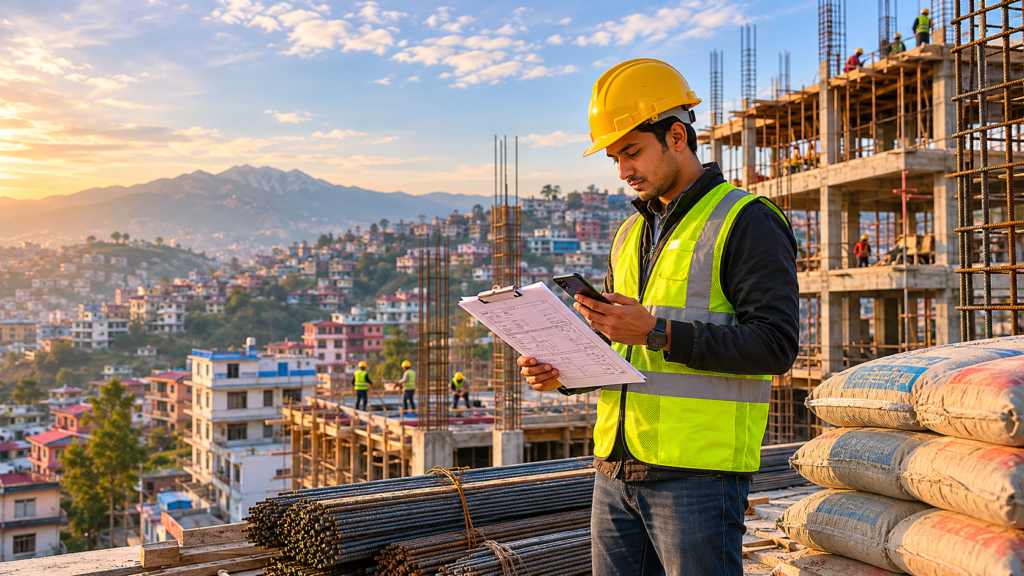
You saved for ten years in Sydney, Texas, the Gulf, or Seoul. You finally bought the land. And now you’re about to hand your life savings to a thekdar you’ve met twice on a video call — convinced he’s going to cheat you the moment your back is turned.
I’ve spent seven years on construction sites across Kathmandu Valley. Let me give you the uncomfortable truth first, because it’s the opposite of what most NRNs expect:
Outright fraud — a contractor taking your advance and disappearing — is actually rare. What quietly drains NRN budgets is something far more common: the small, undocumented leak. A few bags of cement that never make it into your slab. Rebar one size thinner than your drawing specifies. Ten labourers on the muster roll when seven actually showed up. Each one looks tiny. Across a 15-month build, they add up to lakhs.
And here’s the part nobody says out loud: this leak is nearly impossible when there are proper records — and nearly guaranteed when there aren’t. The problem was never trust. It was the absence of a system.
This guide is part of our Complete Guide to Building a House in Nepal from Abroad (2026). Here we go deep on the one fear that stops most people from ever starting.
First, let’s be fair to contractors
Most contractors in Nepal are not crooks. Many are skilled people doing honest work on thin margins. I’ve worked alongside thekdars I’d trust with my own home.
The issue is structural, not moral. The traditional Nepali build runs on verbal agreements, lump-sum deals, and “biswas.” There is usually no written record of what was ordered, what was delivered, who worked, or how a problem got resolved. In that gray zone, even an honest contractor’s margins get fuzzy — and a dishonest one has a wide-open door.
When you’re standing on site every day, you partly close that gap with your own eyes. When you’re 8,000 km away in a different time zone, the gap is wide open. That’s the real reason building from abroad feels so risky — not the people, the missing paperwork.
So this isn’t an article about catching villains. It’s about installing the records that make cheating pointless and protect the honest contractor too.
The 7 real ways NRN money leaks on a Nepali build
These are the patterns I actually see on site — not horror stories, the everyday stuff.
1. Material quantity gaps
You pay for 500 bags of cement; 460 go into the structure and the rest “disappears” or gets used on someone else’s nearby job. Same with steel, bricks, sand, and aggregate. Without a delivery log signed against your BOQ, there’s no way to ever notice.
2. Grade and brand substitution
Your structural drawing says Fe500D TMT rebar; thinner or lower-grade bars go in. Your spec says a premium cement brand (Panchakanya, Himal, Jagdamba); a cheaper bag gets billed at the premium rate. You can’t see the difference in a WhatsApp photo — but your house’s earthquake safety can depend on it.
3. Rate padding
Materials and labour billed above the real Kathmandu market rate. If you don’t know what cement, steel, or a dalan mason actually costs this year, every line item can be quietly inflated 10–20%. (This is exactly why knowing the real 2026 cost to build before you sign matters so much.)
4. Ghost labour
The muster roll shows 12 labourers; 8 were on site. Multiply a few phantom workers across hundreds of working days and it’s a serious number — and it’s invisible unless someone independent is counting heads.
5. Advance-and-milestone games
A large advance is taken, then progress mysteriously slows. Or the foundation gets rushed right before monsoon — locking you into delay and weak, badly-cured concrete. (We break the correct sequence down in Best Time to Build Your RCC House in Nepal; a contractor who ignores the season is a red flag.)
6. Unapproved “extra work” and variation billing
Halfway through, you’re told a wall needs rebuilding or extra steel was “required,” billed without any prior approval. Some of it is genuine. Without a written variation process, you can’t tell which.
7. The family-referral trap
This one is uniquely painful for NRNs. The contractor was referred by your kaka, mama, or didi. Now questioning his bill feels like insulting your own family — so you stay quiet and pay. The relationship that was supposed to protect you becomes the exact reason you can’t challenge anything.
Why being abroad makes every one of these worse
- No eyes on site. Photos show you what someone chose to photograph, not the bag count or the rebar diameter.
- Relatives can’t — or won’t — challenge the contractor. Elderly parents can’t climb scaffolding, and family referrers won’t risk the relationship.
- Time zones slow every decision. By the time you wake up and reply, the pour already happened.
- Emotional pressure. This is your dream home and your parents’ pride. That makes it very hard to play hardball over a disputed bill from across the world.
None of this is solved by “finding a trustworthy contractor.” It’s solved by building accountability into the project from day one.
How to actually protect yourself: the documentation system
Everything below is what we put around every project we manage. You can set it up yourself, or hand the whole layer to us — but the principles are the same.
Get a detailed BOQ before you sign anything — never a lump sum
A lump-sum “I’ll build it for X” deal is where most leaks hide. Insist on an itemised Bill of Quantities: every material, quantity, and rate, line by line. This single document is your reference for the entire build — you check every bill against it. A proper BOQ starts with proper drawings, which is the foundation of our House Design Consultation.
Tie payments to verified completion, not the calendar
Milestone payments (foundation, DPC, each slab, finishing) — and each one released only after that stage is verified complete, not on a date. Hold a small retention (5–10%) until final handover. Never pay far ahead of work done.
Put an independent set of eyes on site
This is the big one. The contractor should never be the only person checking the contractor’s work. An independent engineer or supervisor — answerable to you, not to the thekdar — who inspects pours, checks materials against the BOQ, counts labour, and verifies each milestone before you release money. That’s precisely what our On-Site Construction Supervision service exists to do.
Log materials and labour daily — with timestamped photos
Every delivery, every head count, every floor-wise material entry, recorded the day it happens with dated photos. This is exactly why I built the free Construction Material Tracker app — so an NRN owner (or their site helper) can keep an independent record the contractor doesn’t control, and export it for any bill dispute or final handover.
Test the things you can’t see in a photo
Concrete cube tests for strength. Rebar checked for diameter and weight. Cement checked for freshness and brand. A few thousand rupees of testing protects a multi-crore structure — and it instantly ends grade-substitution.
Keep the relationship and the money separate
If a relative referred your contractor, be warm about the relationship and strict about the records — in writing, the same as you would with a stranger. A professional accountability layer means nobody in your family ever has to be the bad guy. That separation is honestly half of why GharNaksa exists.
Or — hand the whole accountability layer to one team
If managing all of this from abroad sounds exhausting, that’s the entire point of Full Construction Management: one team owns the BOQ, the supervision, the logging, the testing, and the milestone verification, and you get the records and the updates.
Quick checklist: before you release a single rupee
- ✅ Itemised BOQ agreed in writing (no lump sum)
- ✅ Written contract with milestone payments tied to verified completion + retention
- ✅ An independent supervisor who works for you, not the contractor
- ✅ Daily material + labour log with dated photos (kept on your side)
- ✅ Material testing booked (concrete cubes, rebar, cement brand)
- ✅ A written variation/extra-work approval process
- ✅ Confirmed Naksha Pass before any work starts
- ✅ Relationship kept separate from the record-keeping
If you’ve got these eight in place, the seven leaks above mostly close on their own — for honest and dishonest contractors alike.
Is contractor fraud common in Nepal?
Deliberate, run-away-with-the-money fraud is uncommon. What’s common is undocumented “leakage” — material gaps, ghost labour, grade substitution, rate padding — that thrives when there are no written records. Proper documentation removes most of it.
How do I know my contractor is using the right amount of cement and steel?
Check every delivery and usage against your BOQ and structural drawings, log it daily with photos, and run independent material tests (concrete cube tests, rebar diameter/weight). A photo over WhatsApp is not enough on its own — you need a record the contractor doesn’t control.
Should I pay my contractor a large advance?
No. Keep advances small and tie all further payments to verified milestone completion, with a 5–10% retention held until final handover. Paying far ahead of completed work is the single most common way NRNs lose leverage.
Can I really supervise a construction project from abroad?
Yes — but not with photos alone. You need an independent supervisor on the ground who reports to you, daily logging of materials and labour, and milestone verification before each payment. That combination lets you control a build remotely without flying back.
My contractor was referred by a relative — how do I handle the money side?
Stay warm about the relationship, but insist on the same written BOQ, contract, and records you’d use with a stranger. Bringing in a neutral third party to handle verification means no one in your family has to play the bad guy.
Do honest contractors mind all this documentation?
Good ones welcome it. Records protect the contractor too — they prove the work was done right, settle disputes fairly, and justify legitimate variations. A contractor who refuses any documentation is telling you something important.
Final word
The fear of being cheated is the number-one reason NRNs delay building the home they’ve worked years for. But the fix isn’t finding a perfect person to trust blindly from across the world — it’s installing records that make trust unnecessary.
Get the BOQ, tie money to verified work, put independent eyes on site, and keep your own log. Do that, and you can build from anywhere with confidence.
Building from abroad and want a team that handles this accountability layer for you? Message the GharNaksa team on WhatsApp or email [email protected] for a free consultation — we’ll walk you through exactly how we’d protect your specific build.